Software that ships with the airframe: a built-in cabin display.
Building for an LRU inverts most assumptions of modern app development.
Not every interface lives on a passenger's phone. For a business jet OEM, we built the application for a built-in cabin display, installed in the aircraft as a line-replaceable unit (LRU). This is software that ships with the airframe: it boots when the aircraft powers up, runs for the life of the installation, and gets no app-store updates to fall back on.
The hardware is fixed and resource-constrained; you don't get to assume next year's chipset. There is no “refresh the page”: the display must come up ready, every power cycle, and stay responsive for the full duration of every flight. On embedded aviation hardware, “it usually works” isn't a spec, it's a defect.
A display that is on when the aircraft is on.
A 4:1 panel in the cabin wall. Eight functions on a fixed grid, a quick-access row beneath them, and a welcome screen that greets passengers as the aircraft powers up. There is no gesture to learn and no state the unit has not been designed to be in.
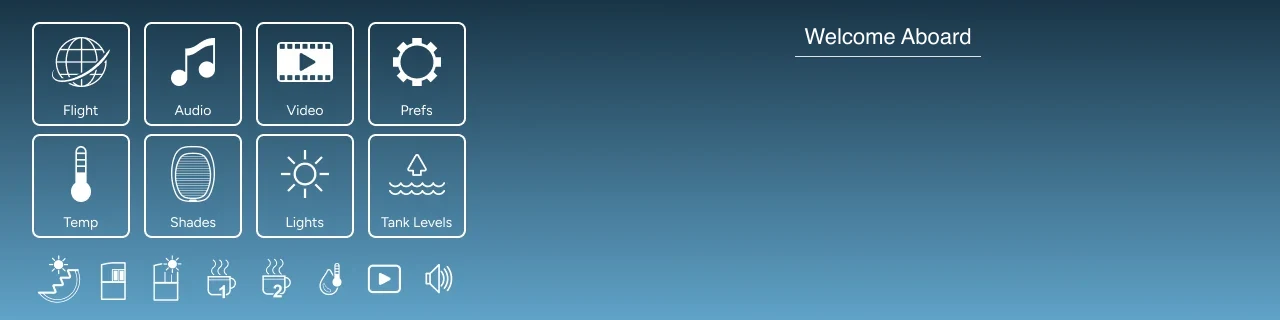
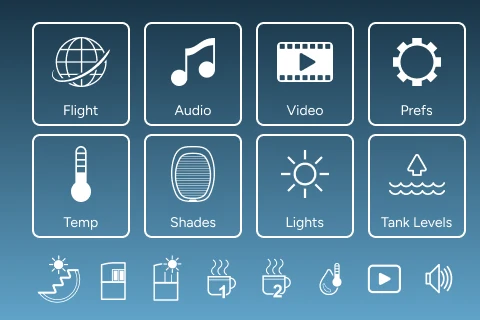 Fixed function gridEight tiles and a quick-access row, identical on every unit in the fleet. Crews are trained once, so the layout never moves.
Screens from the shipping application
An interface engineered for the constraints of embedded aviation hardware.
The full display application
Preferences that live on the unit
Predictable performance
Built for the LRU lifecycle
Aviation-grade discipline
A display that is simply part of the aircraft.
Software that passengers and crew never have to think about: it is on when the aircraft is on, it responds when touched, and it behaves identically on every airframe in the fleet.
A phone app can ask the user to try again. A display bolted into the aircraft cannot. Every state the unit can reach is a state we designed for.